
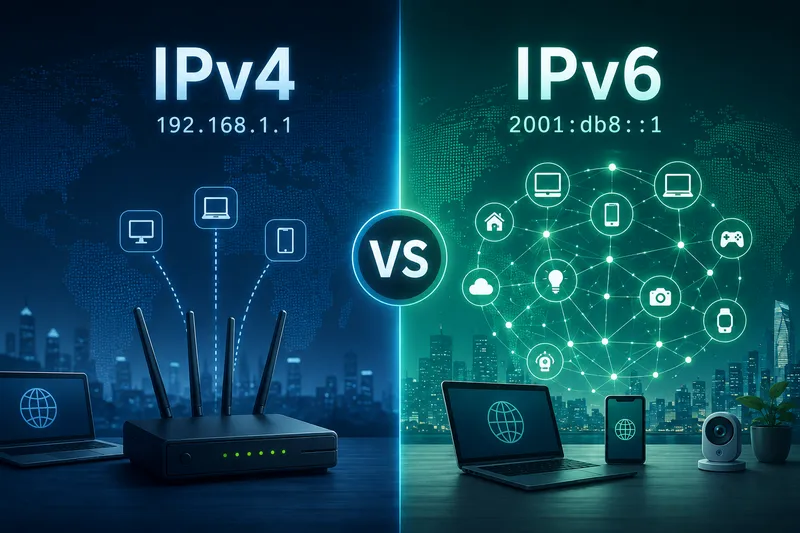
IP addresses are the foundation of all network communication. Without them, devices would not be able to find each other.
Today, two versions exist side by side: IPv4 and IPv6.
But what is the real difference? How are these addresses structured, and why does it matter in practice?
In this article, we take a deeper look at IPv4 and IPv6 – still easy to understand, but with more technical depth.
IPv4 structure
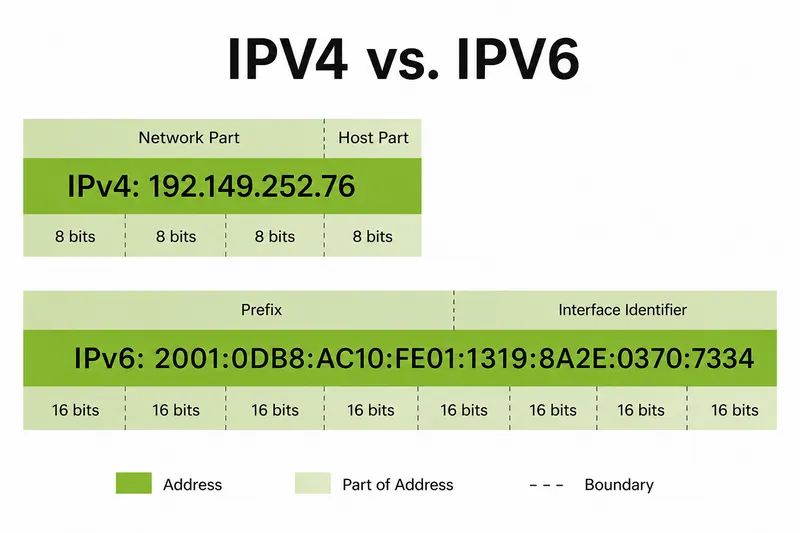
An IPv4 address consists of 32 bits and is written as four octets:
192.168.1.1Each octet represents 8 bits and can range from 0 to 255.
This results in:
2^32 = 4,294,967,296 possible addressesHowever, many of these addresses are reserved (for example private networks or special purposes).
Private IPv4 ranges
- 10.0.0.0/8
- 172.16.0.0/12
- 192.168.0.0/16
These are commonly used in local networks and are not directly reachable from the internet.
IPv6 structure
An IPv6 address consists of 128 bits and is written in eight groups:
2001:0db8:85a3:0000:0000:8a2e:0370:7334Each group represents 16 bits and is written in hexadecimal.
The address space is enormous:
2^128 ≈ 3.4 × 10^38This allows for practically unlimited unique addresses.
Short notation
IPv6 allows abbreviations:
- leading zeros can be omitted
- consecutive zero blocks can be replaced with ::
2001:db8::1Prefix and interface identifier
IPv6 addresses are typically divided into:
- network prefix (e.g. /64)
- interface identifier (host part)
A typical network might look like this:
2001:db8:abcd:0012::/64The host portion is often generated automatically.
Address assignment (DHCP and autoconfiguration)
IPv4
IPv4 usually relies on DHCP to assign:
- IP address
- gateway
- DNS servers
IPv6
IPv6 supports multiple methods:
- SLAAC (stateless autoconfiguration)
- DHCPv6
- a combination of both
Devices can generate their own addresses automatically.
DNS records
IPv4 uses A records:
example.com → 192.168.1.1IPv6 uses AAAA records:
example.com → 2001:db8::1Modern systems usually support both.
NAT and connectivity
IPv4 commonly uses NAT (Network Address Translation).
Multiple devices share a single public IP address.
IPv6 does not require NAT, since there are enough addresses available.
This enables direct communication between devices.
Prefixes and dynamic addressing
Internet providers often assign dynamic IPv6 prefixes.
Typical sizes are /56 or /64.
This means:
- the network part is assigned by the provider
- the host part is generated automatically
The prefix may change over time, depending on the connection.
QoS and traffic handling
IPv6 includes built-in fields for traffic prioritization:
- Traffic Class
- Flow Label
In practice, QoS is still mostly implemented at the network level.
Address size and performance
IPv6 addresses are significantly longer than IPv4 addresses.
This results in slightly larger packet headers.
In modern networks, this has little to no noticeable impact.
Stable and secure infrastructure is no coincidence. With Catarix IT, I help implement setups like this in a clean and reliable way.
Conclusion
IPv4 is simple and widely used, but limited.
IPv6 provides a massive address space and new capabilities, but adds complexity.
Both protocols will continue to coexist for a long time.
Understanding their differences is essential for anyone working with networks.